

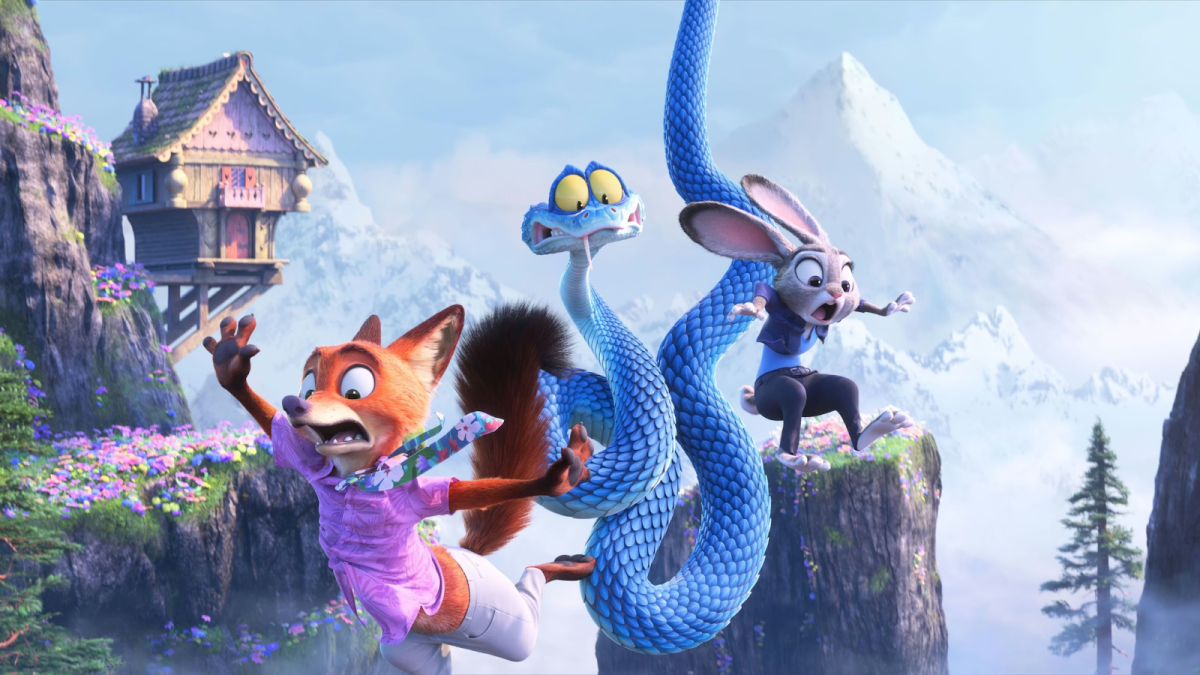
Disney’s animated sequel Zootopia 2 has sparked discussion among PA students due to its portrayal of displacement, political power, and xenophobia. Since its release on Nov. 26, viewers have quickly drawn connections between parts of the fictional storyline and real-world events.
The film’s plot focuses on a group of reptiles who were drawn out of their homeland a century earlier after being accused of a crime they did not actually commit. Protagonists Judy Hopps and Nick Wilde later uncover evidence suggesting the accusations against the reptiles were fabricated by a wealthy Lynx family seeking control over the city’s weather infrastructure and land. The reptiles’ exclusion from Zootopia remained in effect for 100 years, and the movie follows Nick and Judy as they pursue a quest to bring the snakes back to their native land and integrate them into society again.
Co-director Jared Bush told GamesRadar+ that introducing reptiles in Zootopia 2 expanded world-building and allowed for the exploration of differences beyond the original predator-prey dynamic in the first Zootopia.
Some students said the storyline led them to reflect on current social and political issues. For senior Lexi Moon, the film’s depiction of displacement stood out to her. “Their own land has been taken away from them, and they are being villainized in the eyes of the world,” Moon said, adding that some plot events reminded her of current humanitarian crises, including the Israeli-Palestinian conflict.
According to reports from the Human Rights Watch and the United Nations, large-scale displacement has occurred in Gaza and the West Bank throughout the conflict. Human Rights Watch reported in Nov. 2024 that more than 1.9 million Palestinians had been displaced in Gaza during 13 months of war. The United Nations Relief and Works Agency reported in Feb. 2025 that approximately 40,000 Palestinian refugees had been displaced from northern West Bank refugee camps due to intensified military operations.
Moon also observed the film offered commentary on the effects of long-term displacement on certain groups, citing, “Some of the reptiles are so angry about what happened to them that they turn against what they originally stood for,” she said.
Even as someone rarely impressed by animated movies, senior Yagiz Akar admitted that Zootopia 2 was one of the few films in the genre he truly enjoyed. Akar recognized that the film’s critique of collective punishment reminded him of historical examples. In Zootopia, the snake population was discriminated against for centuries due to an incident at the city’s annual Zootennial Gala where a snake supposedly bit an innocent mammal, leading to a widespread fear of reptiles. “They blamed the snakes and got rid of the town like the Holocaust,” Akar stated.
Historian Laura Jockusch of Brandeis University explains that collective punishment was widely used during the Holocaust, with entire groups experiencing penalties and punishments regardless of individual responsibility. Practices like forced complicity result in lasting trauma, as seen in the resentful sentiments shared by the reptiles in Zootopia’s Reptile Ravine.
In the film, the Lynxley family maintains their influence through control of historical records and development plans that would displace residents of the Marsh market, a segregated district for aquatic and semi-aquatic marine animals. Senior Abby Colbert said these elements led her to think about transparency and power in today’s society. Colbert made a connection to government corruption and the tactics powerful people use to consolidate more power. “Current world leaders are trying to do the same things, and keep information to themselves to hide things from the population,” she said.
Moon also commented on the meaning behind Pawbert Lynxley’s character, as he is depicted as publicly supportive of marginalized groups while secretly benefiting from development plans that contradict their interests. “He presents himself as supportive, but his family profits from displacement,” Moon said, adding that the character reminded her of critiques often directed at wealthy public figures.
Student reactions varied. Moon rated the film highly, while Colbert said she preferred the original. Senior Edwin Zheng said he generally enjoyed the sequel while noting an area for improvement. “I liked how Judy and Nick developed, though some new characters didn’t feel as fully explored,” Zheng said.
IB Theory of Knowledge teacher Katie Liakos said films often invite viewers to interpret their meanings through their own experiences. “Art often reflects life and allows people to explore different possibilities based on the choices characters make,” Liakos said.
Despite both clear and hidden messages directed towards adults and children, the movie has definitely gained popularity by grossing $1 billion worldwide.