

Since Feb. 28, 2026, when the first American-Israeli strikes were launched into Iran, the America-Iran war has reshaped the Middle East. With disputes over the Strait of Hormuz and strong pushes for a ceasefire, the war has reached its third month of fighting. At the time of writing, Iran and the U.S. remain in a fragile ceasefire as both sides try to come to an agreement. The causes of this war, however, originate far beyond just this year; conflicts between Iran and Israel and disputes over Iran’s missile program have been ongoing for years.
The origins of the conflict:
A major sticking point for the United States and other countries is Iran’s nuclear program. Iran has pursued a nuclear program since 1957, with major pushes for the program coming later in the 1980s. To bolster their program, Iran has sought ties with China and Russia to support the program’s research, but in 2003, diplomats began intensive efforts to halt their program due to potential dangers and threats. Iran agreed, promising to keep their program solely for nuclear energy purposes.
However, Iran was not transparent in reporting their nuclear activity to the International Atomic Energy Agency (IAEA), says the Council of Foreign Relations. This agency is responsible for scientific and technical cooperation in the nuclear field, according to its website. In 2006, the United Nations Security Council (UNSC) adopted Resolution 1696, legally forcing Iran to suspend its programs and enforcing these restrictions through crippling economic sanctions. Between 2011 and 2015, the compounding effects of international sanctions shrunk Iran’s economy by 20 percent and caused unemployment to rise 20 percent, according to the Council of Foreign Relations.
Eventually, in 2015, a coalition of different nations, including the United States, created the Joint Comprehensive Plan of Action (JPOCA), requiring Iran to reduce its uranium stockpile by 98% in 15 years. The US, feeling that the plan was not comprehensive enough since it did not cover their ballistic missile programs, withdrew from the plan and instituted more economic sanctions. Conversely, Iran began circumventing the JPOCA, stockpiling more uranium, which increased tensions.
After the Israel-Hamas War began in October 2023, tensions between the two escalated. According to AP News, an Israeli airstrike on April 1, 2024, killed seven Iranian military officials in Damascus, Syria. This led to Iran retaliating with 300 missile attacks, most of which were intercepted by Israel. This marked the first time that Iran has directly targeted Israel, reported AP News.
Iran and the United States; What is happening now?
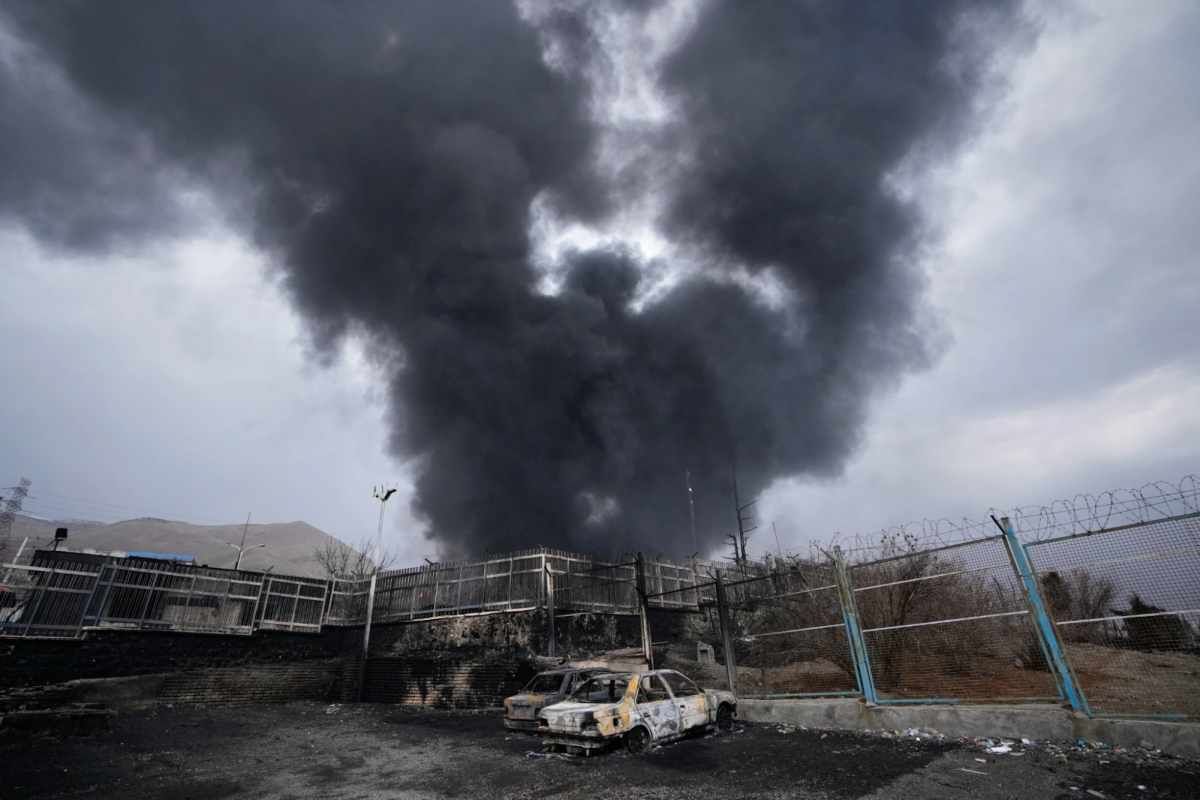
On Feb. 28, President Donald Trump announced that major combat operations were underway in Iran after both the U.S. and Israel launched what Israel called “preemptive strikes,” according to CNN. Their goal was to eliminate Iran’s ambition for a nuclear program. In these strikes, Iranian Supreme Leader Ayatollah Ali Khamenei and the commander in chief of the Islamic Revolutionary Guard Corps (IRGC) were both killed in the conflict. In retaliation, Iran began targeting U.S. military facilities and Israeli energy and civilian infrastructure in the Gulf States.
Mojtaba Khamenei was named the new supreme leader of Iran after the initial strikes, and he directed the IRGC to limit traffic through the Strait of Hormuz, the maritime channel linking the Persian Gulf and the Gulf of Oman. 20% of the world’s oil and natural gas passed through the Strait of Hormuz in 2024, according to ABC News. President Trump gave Iran an ultimatum to open the Strait to all commercial vessels within 48 hours, and in response, Iran opened the Strait to all non-hostile vessels.
Since the onset of the war, Iran’s ambassador has reported that more than 1,500 civilians have been killed so far, and 3.2 million have been displaced, according to the Council of Foreign Relations. On March 23, the U.S. announced that both sides were contemplating an end to the war, the first indication that any side was willing to come to the negotiation table. On March 26, the president announced that a 10-day pause would ensue, temporarily stopping the bombing on Iran’s nuclear energy plants.
The pause would have ended on April 6, but President Trump extended the deadline to April 7, citing that peace talks were still ongoing. Just hours before the April 7 deadline expired, Iran and the U.S. agreed to a two-week ceasefire, opening the Strait of Hormuz to commercial vehicles.
However, on April 8, Israel launched heavy bombing against Hezbollah in Lebanon, prompting outcries from Iran, claiming that the ceasefire had been broken and reclosed the Strait. The president announced a naval blockade, blocking Iranian ports along the Strait, and Vice President J.D. Vance traveled to Iran for peace talks but returned to the U.S. with no resolution. President Trump extended the ceasefire indefinitely, but the naval blockade would remain, and navigation through the Strait of Hormuz remains extremely limited.
Before the war, 3,000 ships used to travel through the Strait each month, but since the war has made travel through the Strait immensely difficult, only a handful of ships have gone through each day, according to BBC. BBC also pointed out that a prolonged naval blockade and extended blockage of the Strait of Hormuz could lead to further damage to the global economy. The war has already pushed up petrol and food prices in the U.S. According to Forbes, gas prices in the U.S. have risen 58% since the beginning of the war. The blockages also continue to limit access to other crucial resources, like aluminum.
The legality behind the war in Iran:
Many government officials in Congress have wondered whether President Trump’s decision to attack Iran was within his constitutional rights as commander-in-chief. Congress only has the power to declare war, but the president can authorize military actions through his power as commander-in-chief. President Trump utilized this power, claiming that the strikes against Iran were military actions, not an act of war, according to USA Today.
Under the War Powers Act of 1973, the act that grants the president the right to take military actions, the president is also required to notify Congress within hours of military action, and prohibits troops from being deployed for more than 90 days before war is declared. Secretary of State Marco Rubio briefed Congress before the strikes began.
Though the U.S. has carried out military strikes and Iran has retaliated, the U.S. has not formally declared war. Democrats in Congress called for a vote on March 4, 2026. For the most part, lawmakers are divided along party lines, but during the vote, four democrats split from the party, ending with a 212-219 vote, allowing President Trump to continue his military actions, reported USA Today.
At the time of writing, the ceasefire is still ongoing between Iran and the U.S., but Iran claims that the United States has breached it, after U.S. strikes on a southern port created more military conflict, according to CBS News. The U.S. has proposed a 15-point plan to end the war, including sanctions relief, limits on Iran’s nuclear program, and reopening the Strait, but Iran refused these terms, stating their own demands. As the fragile ceasefire continues, both sides continue to negotiate, trying to come to a settlement that would satisfy all involved.